4. A world of Druids and Romans far removed from Asterix
The relationship between Druids and Romans has always carried an air of mystery. This is largely due to the scarcity of sources on the Druids and to the fact that almost all surviving accounts were written by Roman authors. Druids fulfilled religious, legal and educational functions and were regarded as transmitters of knowledge. They were believed to possess extensive understanding of astronomy, the natural worldand the law.
Roman sources, however, often depict the Druids in an ambivalent or even negative light, with references to human sacrifice and manipulation. In popular culture, shaped above all by Asterix and Obelix, Druids are instead portrayed as brewers of magic potions, spell-casters and figures of exceptional wisdom.
In Bellini’s Norma, the darker depths of the human soul are revealed through a Druid priestess who deceives not only her people but herself over many years. The overall effect is a form of demystification that echoes aspects of the Roman view of the Druids, without constituting a deliberate reproduction of that perspective.
5. The emotional power of Vincenzo Bellini’s music
From the famous aria Casta Diva to Norma’s heart-rending scenes and onward to moments of boundless rage, irrationality and near madness, Bellini weaves almost the full spectrum of human emotion into his masterpiece. In doing so, he creates a musical arc that stretches from the most intimate contemplation to the very limits of human experience.
Bellini’s music does not primarily follow external action, but rather the inner states of his characters. Every melody, every repetition and every moment of apparent stillness gives voice to an inner emotional movement. It is precisely through the slow unfolding of his melodic lines that an extraordinary intensity emerges, making the unspoken audible and turning Norma into one of the most compelling psychological portraits in the history of opera.
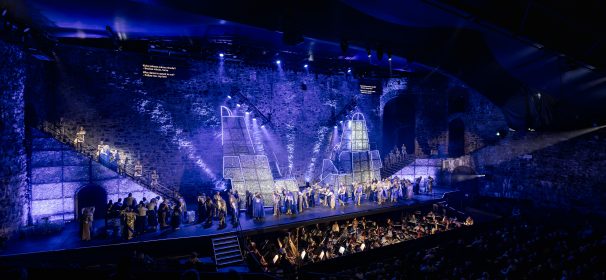
Norma & Lisette Oropesa at Olavinlinna Castle on July 29 & August 1 at 7pm.